



The global shift toward a circular economy is fundamentally reshaping the plastics industry, with high-quality recycled PET (rPET) at its core. As regulatory pressure mounts and consumer demand for sustainable packaging grows, the ability to produce clean, consistent, and high-performance rPET is no longer an advantage—it's a requirement for market access.
From food-grade bottles and high-end fibers to engineering-grade materials, the applications for premium rPET are expanding rapidly. Meeting these stringent end-use specifications demands more than basic recycling; it requires an optimized, intelligent PET bottle recycling line capable of delivering flakes or pellets with precise intrinsic viscosity (IV), exceptional purity, and batch-to-batch consistency.
Before delving into the detailed process, it's critical to understand the unique properties of PET that make this circular ambition possible, and why the year 2025 represents a pivotal moment of accountability and technological advancement for recyclers worldwide.
What Is PET and Why Is It Highly Recyclable?
PET (Polyethylene Terephthalate) is a thermoplastic polyester created through a polycondensation reaction between terephthalic acid (or dimethyl terephthalate) and mono ethylene glycol (MEG).
Each repeating unit contains:
- An aromatic ring → providing clarity, strength, and stiffness
- An ester linkage (–COO–) → allowing PET to be re-melted and reprocessed
- An ethylene glycol segment → giving flexibility and processability
Depending on cooling conditions, PET can be amorphous and transparent or semi-crystalline and opaque.
Key Physical & Performance Properties
- High clarity and gloss
- Excellent gas barrier properties (especially CO₂)
- Strong mechanical strength and impact resistance
- Moderate melting temperature (~250°C), enabling energy-efficient reprocessing
Why PET Is One of the Most Recyclable Plastics
- Can be melted, cooled, and re-melted multiple times with controlled property loss
- Can be chemically depolymerized into monomers (TPA + EG) and rebuilt into like-virgin PET
- Widely recognized as Resin Identification Code #1
2025 Global Regulatory Update: Why PET Recycling Matters More Than Ever
Worldwide regulations in 2025 have accelerated demand for high-quality rPET, especially for bottle-to-bottle circularity:
- United States – California SB 54 mandates 25% PCR in PET beverage bottles by 2025; multiple states expand EPR frameworks.
- European Union – SUPD requires ≥25% rPET in beverage bottles by 2025; PPWR elevates recyclability standards.
- India – Stronger EPR obligations under PWMR and FSSAI’s conditional approval for food-grade rPET push demand for high-purity flakes and pellets.
These requirements increase the need for efficient sorting, deep-cleaning hot washing, decontamination, and pelletizing systems globally.
PET Bottle Recycling Process Overview
Recycling PET bottles involves a sequence of interconnected steps designed to remove contaminants and convert waste bottles into high-quality flakes or pellets. Below is a breakdown of the typical process flow.
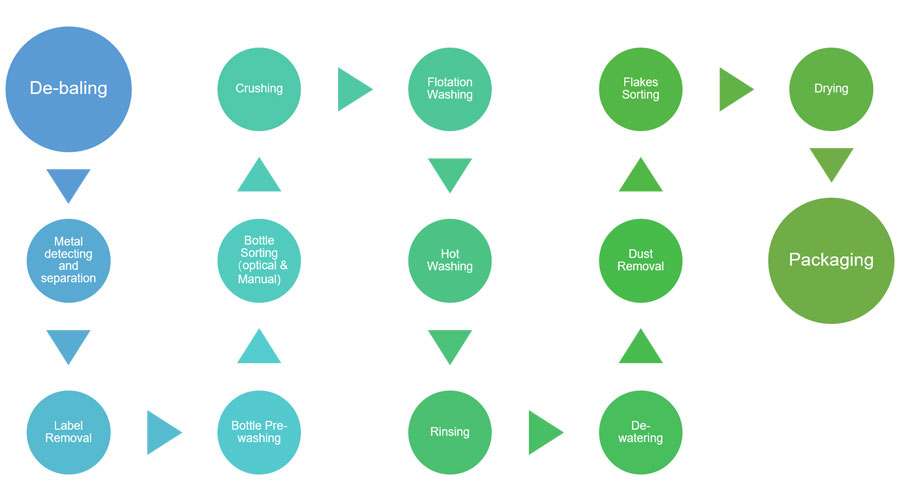
-
Collection and Sorting
The first step before the PET bottle recycling process is to collect post-consumer PET bottles from various sources. In European and American countries, specialized large-scale Materials Recovery Facilities (MRFs) are utilized to categorize reclaimed recyclable materials such as paper, plastic, glasses, and metal. Plastics, after undergoing multiple rounds of sorting, can be transformed into homogenous bales of single-polymer compositions. These bales are then transported to plastic recycling facilities for further processing.
-
De-Baling
Cut off the baling wire of the PET bottle bale by manual or automatic device, and make the bottles loose into a bottle baler. There are various types of bale breakers when you configure the process, you should consider the density of the bottle bale. An automatic device will save a lot of labor.
Three types of bale breakers from BoReTech, the right choice can support easily breaking up the bottle bales into loose.

Horizontal Type
Vertical Type
Horizontal Type -
Metal Detection and Removal
Ferrous metal separation can be achieved by a magnetic drum, magnetic over-belt, or metal detector with a flapping device. To separate the non-ferrous metal, we recommend the eddy current in the later step.

Magnetic Drum
Magnetic Over-belt
Flapping Device -
Whole Bottle Impurity Removal
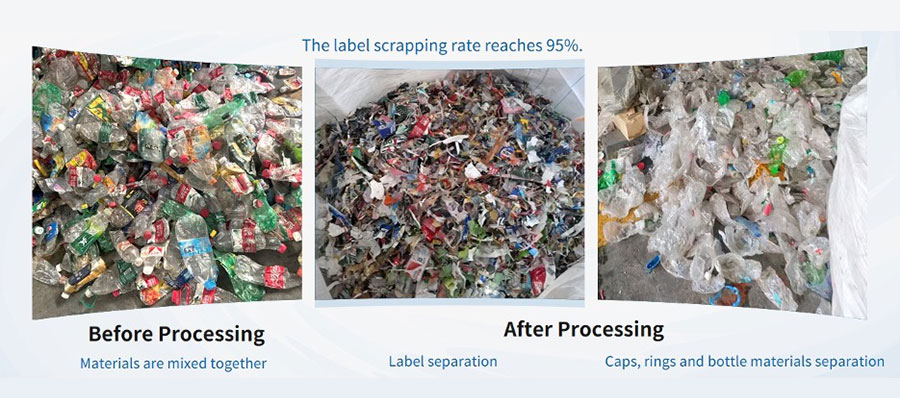
The PET recycling process after consumption will be mixed with various foreign impurities, such as sand, non-plastic foreign bodies, metals, etc., and there are also non-PET materials such as labels, caps, and bottle rings with the bottle itself. If these impurities are not effectively separated, they will result in low purity of the recovered material, additional wear and tear on the cleaning equipment, and operational failures of the equipment. Choosing the right sieving machine to separate these impurities plays an important role in the entire PET bottle recycling and cleaning process.
According to the cleaning process, we provide two types of sieving machines: dry trommel and disk screener. The efficient screening of the specific process guarantees post-cleaning efficiency and the quality of the final bottle.
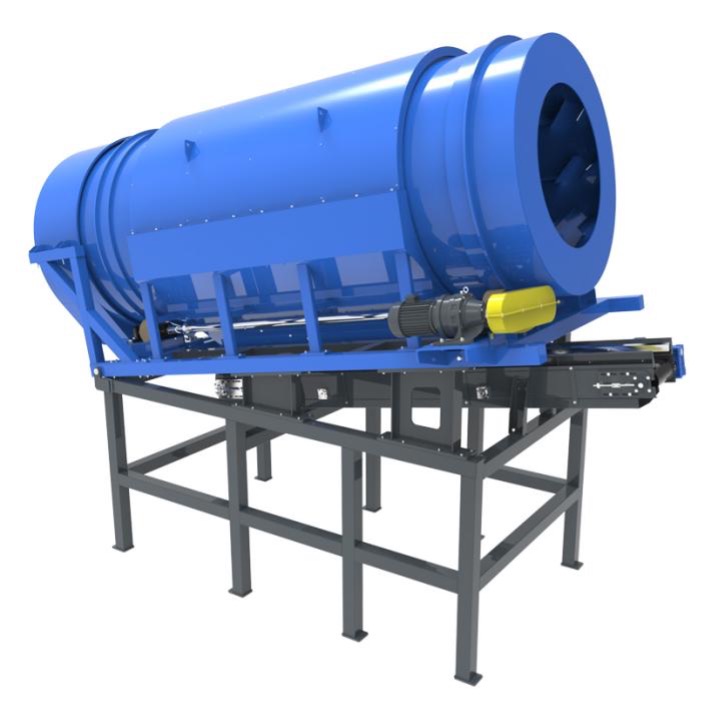
Dry Trommel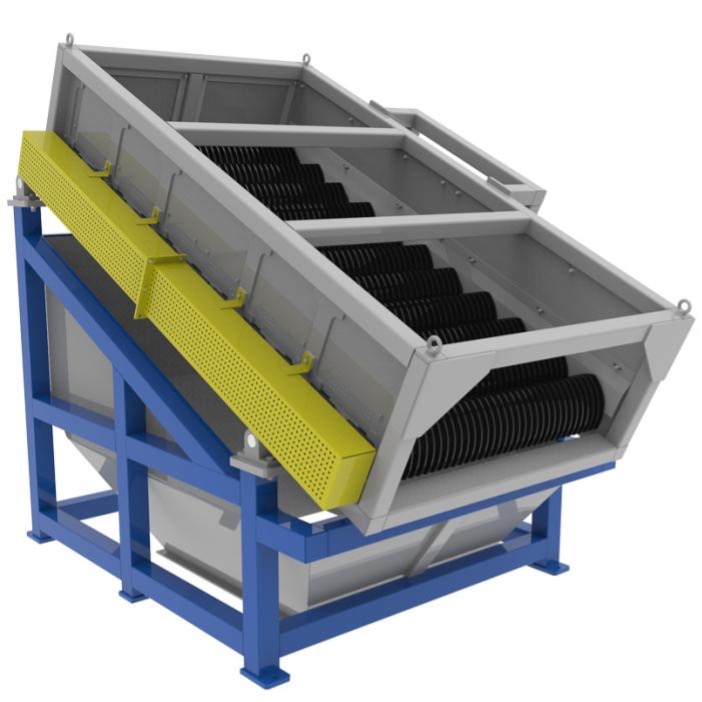
Disk Screener -
De-labeling
This is a set of three functions of label scrapping, label removal, washing in one of the equipment, reduce the number of equipment and plant utilization, effectively improve the standard removal conditions, improve the label removal rate and finished product quality, reduce the impact on the environment, to achieve a win-win situation of production efficiency and environmental benefits.
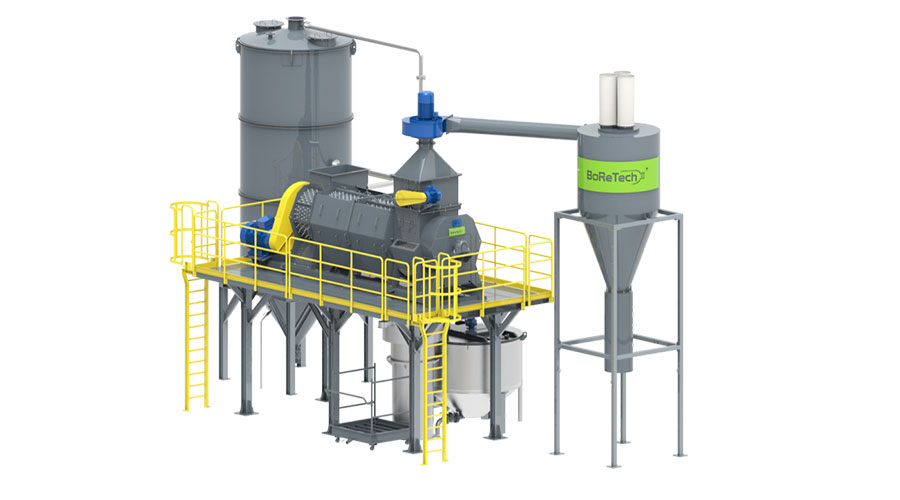
BORETECH launched a new type of Label scrapping machine - COMPACT PREWASHER
- The Boretech’s Compact Prewasher integrated the functions of label crapping, separation, and washing into a single unit. Compared to traditional processes, the equipment footprint for achieving these functions is reduced by 58%, and the total operating power of the equipment is decreased by 46%.
- A specially designed mechanical structure addresses the issue of a messy and dirty production environment caused by the operation of traditional equipment.
- It enhances the label removal rate and the quality of the finished product, with a label scrapping rate of ~95% and a label removal efficiency over 99%. it can process PET bottles even with full body shrink-sleeve labels, delivering food-grade rPET flakes.
- The patented blade design minimizes bottle damage (material loss rate: < 1%) , allowing for a suggested blade replacement cycle of processing up to 5,000 tons of material, even with a few hard impurities in it.
- The built-in negative pressure cyclone enables self-cleaning, prevents clogging, and separates labels and impurities for collection in line.
- It reduces the need for maintenance, ensures production continuity, and increases profits for investors.
-
Hot Washing
Soaking and washing flakes, heating the cleaning medium with steam or heat-conducting oil, and dosing the detergent and NaOH to improve the cleaning effect, soften and remove the impurities attached to flakes; oil will be emulsified during the hot washing. Temperature control
The following are the key factors for the Hot Washing Process in PET Bottle Recycling.
- Automatic Temperature Control
- Washing speed
- Washing dwell time
- Detergent
Qualitative analysis of PET bottle balers in the early stage will support the hot washing process.
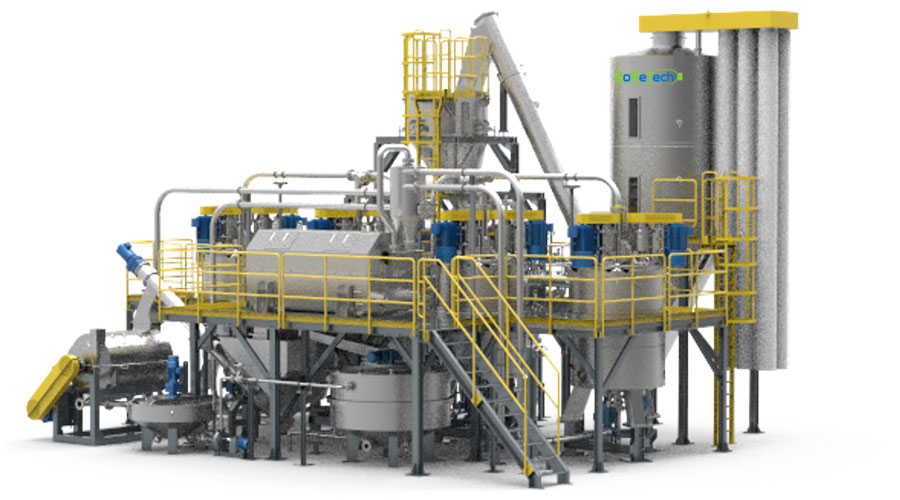
BORETECH INTENSIVE HOT WASHING MODULE is one of the great choices
- The process flow is rationalized, compacted, simplified, and occupies less area.
- Unity and renewing of temperature and chemical concentration for batch flake washing.
- The mechanical friction force and friction between materials significantly improve the flakes-washing effect.
- Patented shaft with paddles produces high-speed water flow through the rotary, washing flakes to peel off labels and glues and reach a perfect washing effect;
-
Dewatering
The moisture content of recycled PET flakes is a crucial quality indicator in PET recycling. The efficiency of mechanical dewatering directly impacts the quality of the final product and energy consumption during the recycling process. Excessive moisture in the flakes not only increases subsequent transportation and storage costs but also affects the quality and stability of recycled pellets. Currently, many traditional machines offer limited dewatering performance, failing to meet high production standards.
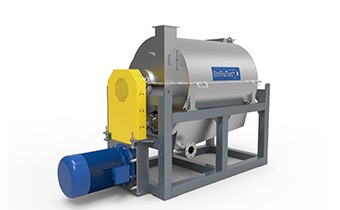
Boretech’s Self-Clean Hydro Dryer is a centrifugal dewatering equipment with automatic cleaning function. Under the processing capacity of 3t/h, the water content of the material in the dehydrator is less than 1.8%, and the material loss rate is less than 1%.
- Significantly reduces labor requirements.
- Mitigates mechanical impact, minimizing material loss.
- Self-cleaning function prevents screen mesh blockages.
- Provides efficient and stable dewatering performance.
- Quick disassembly and installation for easy maintenance and spare part replacement.
- Enables long-term continuous operation without the need for shutdown cleaning.
-
Label separation
The excessive PVC content is fatal to the production of downstream superfine denier filaments. Boretech has developed a label separation device that can accurately and quickly sort residual labels for the removal of heat-shrinkable labels. This device has been verified by our clients’ recycling plants and has been put into use on the recycling and cleaning line of PET bottles, greatly improving the label removal effect.
Boretech's Mega Aspirator can customize the separation channels according to the production capacity requirements of customers. It can accurately and quickly separate lightweight impurities such as labels from PET flakes. Through multiple separations in a single channel of the device, the final PET flakes can meet higher quality standards, with a label removal rate of up to 99%.
- Compared with traditional aspirators, this product is both high - yield and efficient. The processing capacity reaches 6 - 8T/h, and the separation loss rate is less than 1%.
- The device has an innovative structure and key technologies, and has obtained relevant patents.
- The label suction efficiency is as high as 99%, and the proportion of mistakenly carried flakes is less than 1%, which is significantly better than the plastic recycling industry standard.
- It comprehensively uses means such as variable - frequency control, signal feedback linkage, and manual intervention judgment to adapt to working conditions such as different label materials, sizes, and specific gravities. It can be applied to the label separation of raw flakes after cold washing as well as the precise label separation of residual labels after hot washing.
-
Rinsing Suction
There are several types of rinsing machine to be considered, high speed rinsing tank, screw rinsing tank and combined with ULTRASONIC WASHING MACHINE.
The rinsing process is to separate suspended solids by different gravity of materials.
- High-speed rinsing machine with high-speed stirring to wash the flakes by water vortex force.
- Screw-type washing, further rinsing to separate from semi-floating impurities.
- Through cavitation, the dirt, glue, and impurities on the surface of the flakes are impacted, and then the impurities are separated to achieve the cleaning effect.
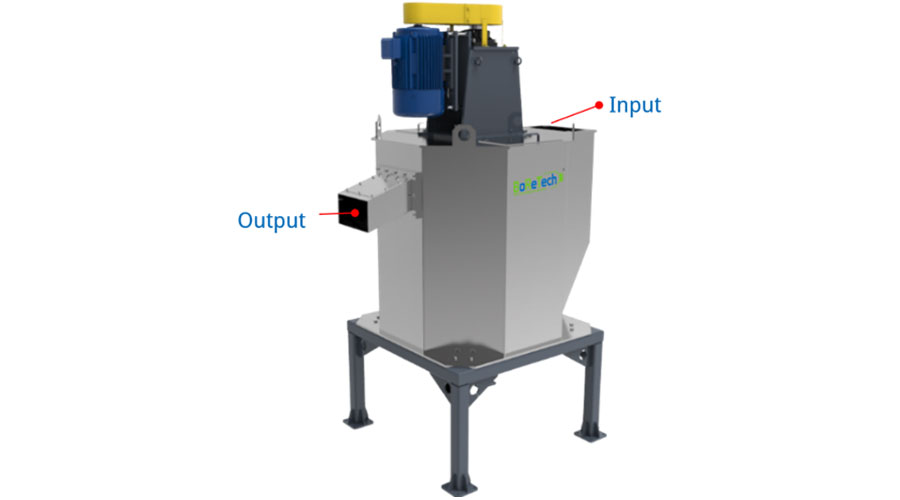
BORETECH HIGH-SPEED RINSING MACHINE
In addition to the main PET bottle recycling processes mentioned above, there are indeed numerous processing methodologies applied for PET bottle recycling based on the diverse conditions of the PET bottle sources. Presently, the challenge lies in the persistent presence of impurities within PET bottles on a global scale. These impurities are a consequence of the ongoing utilization of PET bottles that incorporate multiple materials. Consequently, the successful implementation of PET bottle recycling and cleaning hinges on the adept selection and integration of processing techniques tailored to the specific characteristics of the PET bottles being processed.
-
Pelletizing
For high-performance applications such as bottle-to-bottle, converting PET flakes into pellets is crucial. The pelletizing sequence includes:
-
Pre-Drying & Crystallization
Flakes are dried to extremely low moisture levels and crystallized to prevent sticking or hydrolysis during extrusion.
-
Melt Extrusion & Multi-Stage Filtration
Flakes melt under controlled temperature and vacuum.Filtration removes:
- Paper & label residues
- Gel particles
- Fine contaminants
- Unmelted fragments
This ensures melt purity required for packaging-grade rPET.
-
Pelletizing Technologies
- Strand Pelletizing → simple, stable, general-purpose pellets
- Underwater Pelletizing → uniform spherical pellets, preferred for bottle-grade applications
-
Solid-State Polycondensation (SSP)
For food-grade rPET, SSP is essential. It meets stringent certification standards such as FDA and EFSA for food contact materials and:
- Rebuilds intrinsic viscosity (IV)
- Removes volatiles and oligomers
- Restores mechanical strength
-
Cooling, Classification & Packaging
Pellets are cooled, screened, and classified before being filled into big bags or silos.
Why Pelletizing Matters
Pelletizing gives recyclers:
- Stable bulk density
- Uniform IV
- Improved color and processability
- Higher value and broader application compatibility
-
Customized Modules for Diverse PET Sources
Recyclers handle bottles from many origins deposit systems, curbside waste, export bales, industrial scrap.BoReTech supports modular upgrades such as:
- Additional friction or hot washing
- Optical sorting integration
- Fines & glue removal units
- Pelletizing & SSP integration (project dependent)
Enhancing Profitability in a Competitive Market To help PET bottle recycling plants improve profitability, BoReTech offers specialized solutions such as:
- Ultra-Small PET Flake Washing Systems: Efficiently clean and recover fine or undersized PET fragments that are often lost in conventional processes, increasing overall yield.
- By-Product Recovery & Cleaning Modules: Capture and purify auxiliary materials (e.g., labels, caps, HDPE) for resale or reuse, creating additional revenue streams and reducing waste disposal costs.
This flexibility ensures recyclers can meet varying contamination and quality requirements.
Choosing the Right PET Recycling Machinery
When selecting equipment, recyclers must consider:
- PET source and contamination level
- Desired flake/pellet quality
- Downstream applications (fiber, film, preform)
- Regional regulations (PCR requirements)
- Automation level & maintenance needs
Proper equipment design significantly improves operational stability, yield, and material quality.
Further Reading and Related Insights
To deepen your understanding of bottle-to-bottle circularity and to see how PET recycling technologies are applied in real industrial environments, the following resources provide practical examples and additional technical context:
- 3 Minutes to Know PET Bottle-to-Bottle Closed Loop Recycling
- Case Study: How BoReTech Supports Turkey’s PET Recycling Industry
FAQ
-
How are post-consumer PET bottles collected compared to industrial PET waste?
Post-consumer bottles are collected through curbside systems, drop-off centers, and deposit-return programs. They contain higher contamination labels, caps, liquids requiring intensive sorting and washing.Industrial PET waste comes directly from factories as clean scrap, making it easier to recycle into high-quality rPET.
-
How is rPET used after the recycling process?
High-quality rPET is used to manufacture:
- Beverage bottle preforms
- Food-grade trays
- Thermoforming sheets and films
- Strapping materials
- Polyester fiber for clothing, carpets, automotive interiors
- 3D printing filament and insulation materials
-
What is the difference between mechanical and chemical PET recycling?
- Mechanical recycling cleans, melts, and pelletizes PET efficient and widely used for bottle recycling.
- Chemical recycling depolymerizes PET into monomers (TPA + EG), then repolymerizes it into like-virgin PET, ideal for highly contaminated or mixed-material PET but more energy-intensive.
Mechanical vs Chemical PET Recycling — Comparison Table
Category Mechanical PET Recycling Chemical PET Recycling Category Mechanical PET Recycling Chemical PET Recycling Definition Physical reprocessing of PET through sorting, washing, melting, filtration, and pelletizing Depolymerizing PET into TPA + EG and repolymerizing into virgin-like PET Process Type Physical / Mechanical Chemical / Molecular Main Steps Sorting → Washing → Flakes → Extrusion → Filtration → Pelletizing Depolymerization → Purification → Repolymerization Best For Clean PET bottles from post-consumer or industrial sources Contaminated, colored, multilayer, or low-quality PET waste Material Purity Needed Medium to High Low (can accept heavily contaminated PET) Output Material rPET flakes or pellets (may have slight IV loss) Like-virgin PET resin with fully restored molecular weight Intrinsic Viscosity (IV) Slightly reduced after multiple cycles Fully restored; can exceed mechanical rPET IV Energy Consumption Lower Higher (thermal + chemical energy required) Cost Lower CAPEX & OPEX Higher CAPEX & chemistry cost Environmental Impact Lower carbon footprint Higher CO₂ emissions but recovers more difficult waste Applications Bottles, films, strapping, fibers, thermoformed sheets Bottle-to-bottle, food packaging, high-purity applications Key Advantage Efficient, economical, widely available Handles hard-to-recycle PET and produces virgin-quality resin Key Limitation Quality degrades after multiple cycles High cost, complex infrastructure needed -
Is PET always recyclable?
Recyclability depends on bottle design. Colored PET, multilayer PET/PE structures, PVC labels, and heavy contamination reduce recyclability.
Empowering Sustainable Choices with BoReTech
BoReTech delivers advanced, modular PET recycling solutions aligned with global 2025 standards.With decades of experience in PET washing, decontamination, and pelletizing systems, we support recyclers worldwide in achieving consistent, high-quality rPET production.
For more information about our ES Process PET Bottle Recycling System, contact our engineering team or explore our product pages and social media channels.