

Agricultural Film Washing & Recycling Machine: Technical Guide to Processing Contaminated PE Films
2026-01-06

Agricultural films, such as mulch film, greenhouse covers, silage wrap, and banana plantation film are among the most challenging PE waste streams to recycle. Compared with post-consumer packaging films, agricultural films typically contain heavy soil loads, sand, organic matter, and high moisture. Achieving stable, high-quality recycled PE requires a washing system engineered specifically for agricultural conditions.
This guide provides a technically oriented overview of the agricultural film recycling process, major equipment configurations, performance considerations, and engineering insights for recyclers planning or upgrading a washing line.
What Is an Agricultural Film Washing / Recycling Machine?
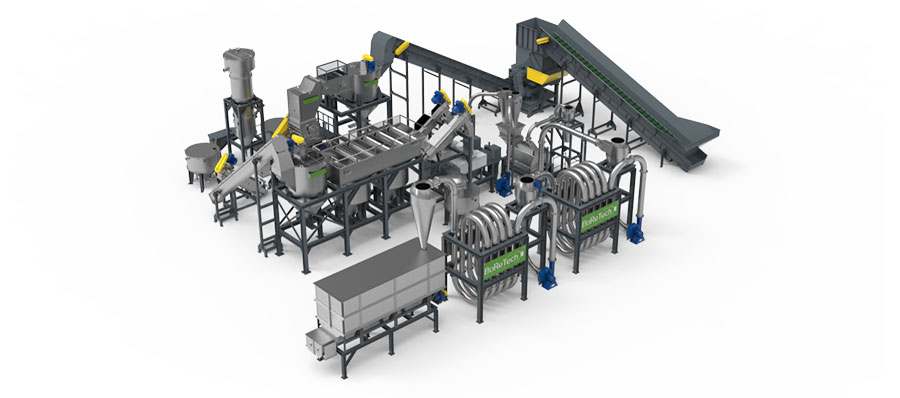
Agricultural film washing systems are complete recycling lines designed to clean, separate, and dry heavily contaminated LDPE/LLDPE films collected from agricultural use. These systems must handle extreme contamination and variability in moisture and soil content, making them more advanced than standard PE film washing lines.
These lines integrate multiple washing stages, friction cleaning, density separation, and mechanical drying to remove soil and embedded contaminants, producing flakes suitable for extrusion or pelletizing.
Key functions include:
- Removing soil, sand, organic matter, and fertilizers
- Reducing moisture to stable processing levels
- Producing clean LDPE/LLDPE flakes
- Supporting downstream applications in extrusion and molding
Processed Materials and Applications
Agricultural film washing lines must accommodate a wide range of film types, each with its own contamination profile and degradation pattern.
Common Input Materials
| Material Category | Specific Classification | Module Options |
|---|---|---|
| PE Agricultural Film | Mulch Film |
Basic / Basic + Dry Impurity Removal Module |
| Greenhouse Film | Basic | |
| PE Industrial Film | Consumer & Packaging Film | Basic / Basic + Hot Washing & Deinking |
| Heavy-Duty Packaging Film | Basic | |
| PP Woven Bags | Agricultural, Food, Construction Use | Basic / Basic + Deinking |
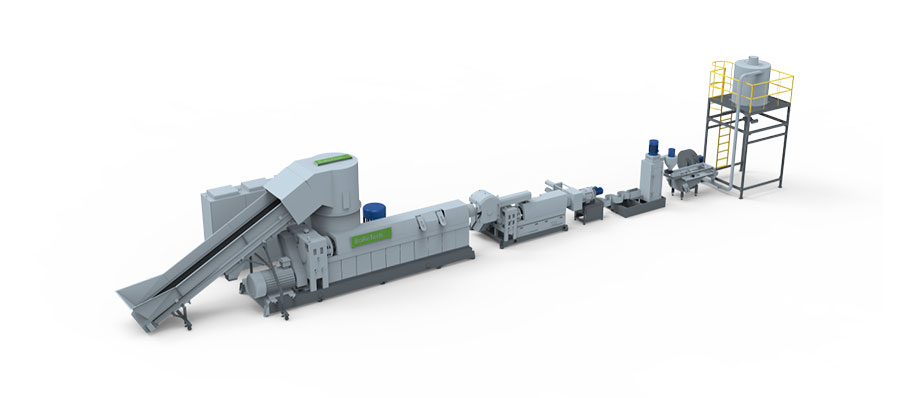
Integrated Film Washing & Pelletizing Solution
Efficient Production, Energy-Saving Operation
The washing process delivers high-quality material for pelletizing. A specially designed extruder screw enhances compression, conveying, and plasticization, thus improving pellet quality. Digital temperature control with efficient cooling ensures stable melting. Low-noise, hardened gear reducers for continuous high-speed performance, reliability, and durability.
Agricultural Film Recycling Process: Step-by-Step Engineering Overview
Agricultural film recycling involves multiple mechanical, hydraulic, and thermal treatments. Each stage contributes to reducing contamination and achieving stable downstream processing.
Shredding
Reduces bulky film into smaller pieces to ensure stable feeding and easier cleaning.
Pre-Washing
Removes soil, sand, and loose contaminants before entering intensive washing stages.
Crushing
Further reduces material size into uniform flakes for efficient downstream processing.
Inclined Friction Dewatering
Uses high-speed friction to remove surface water and light contaminants from the flakes.
High-speed Washing
Provides intensive mechanical scrubbing to eliminate embedded dirt, ink, and residues.
Float Washing
Separates plastics from heavy impurities through density-based water flotation.
Inclined Friction Dewatering
Further decreases moisture and removes residual fines after washing.
Squeezing
Compresses and dewaters soft films to significantly reduce moisture content.
Centrifugal Dewatering
Spins off remaining water to achieve stable, low-moisture flakes.
Hot Air Drying
Uses heated airflow to bring moisture down to levels suitable for storage or pelletizing.
Buffer
Temporarily stores cleaned and dried flakes to stabilize feeding for downstream equipment.
The basic module, combined with optional modules, enables the delamination of multi-layer films, separation of paper label, and removal of organic residues, sediment, adhesives, printing ink, and volatile organic compounds.
Basic Module for Recycling Post-Industrial and Post-Consumer Films
▶ Shredding Module
Films often come in irregular sizes, are bulky, and prone to tangling. The shredder breaks them into smaller pieces, facilitating feeding and ensuring efficient operation of downstream processes such as dry impurity removal.
▶ Pre-Washing & Crushing Module
Materials undergo intensive washing in a high-speed pre-washer, where impurities settle at the bottom and are periodically discharged into the water circulation system for removal. The cleaned material is then transported via water flow to a crusher for wet grinding, which also performs friction washing, extending blade life. The crushed material and water mixture enter a friction dewatering machine, where impurities are separated and discharged with water through the mesh.
▶ Rinsing & Squeezing Module
After high-speed rinsing and float washing, the material enters a friction dewatering machine. Impurities are carried away by water through the mesh under friction, achieving washing and separation. The material then undergoes squeezing to further reduce moisture content.
▶ Dewatering & Drying Module
Mechanical dewatering reduces moisture content to below 8%, and fines are collected via a negative pressure conveying system. The material then undergoes two stages of hot air drying to achieve a moisture content of ≤5%.
Optional Modules for Recycling Different Types of Films
▶ Dry Impurity Removal Module
Effectively removes high levels of solid impurities (e.g., from agricultural mulch films) without using water.
▶ Hot Washing with Detergent Module
Wash films to remove labels, adhesives, printing ink (including resins, pigments, solvents), and heavy oil-based contaminants. Effectively removes residual adhesives, ink, and oils on the film surface, ensuring quality in subsequent processing (e.g., avoiding black spots during pelletization or defects in recycled films).
Optional Modules for Recycling Different Types of Films
Dry Impurity Removal Module
Effectively removes high levels of solid impurities (e.g., from agricultural mulch films) without using water.
Hot Washing Module
Wash films to remove labels, adhesives, printing ink (including resins, pigments, solvents), and heavy oil-based contaminants, ensuring quality in subsequent processing (e.g., avoiding black spots during pelletization or defects in recycled films).
Specifications
| Required Area (m²) | 730 |
|---|---|
| Installed Power (kW) | 670 |
| Operators (persons) | 2 |
| Power Consumption (kWh) | 268 |
| Water Consumption (m³) | 3 |
| Steam Consumption (kg) | 240 |
| Bulk Density (kg/m³) | 20–50 |
| Material Size (mm) | 30–40 |
| Moisture Content (%) | ≤5% |
| Impurity Content (%) | ≤1% |
Actual values vary with film condition, equipment configuration, and automation levels.
Why Agricultural Film Requires Specialized Recycling Technology
Agricultural films contain contaminants and soil levels far above those of post-consumer packaging films. These conditions demand a more robust washing configuration engineered for abrasion resistance, stable feeding, and intensive scrubbing capability.
Key engineering challenges include:
- High soil and sand abrasion
- Water-saturated films with mud
- Variability in thickness and degradation
- Organic matter contamination
- Stable feed requirements for extrusion
Standard film washing lines are typically not designed for these loading conditions, making specialized agricultural systems essential for consistent quality.
Frequently Asked Questions (FAQ)
-
How contaminated can the incoming film be?
Agricultural films can carry extremely high soil loads. With proper pre-washing and friction modules, even mud-heavy films can be processed effectively.
-
What is the final output?
Clean LDPE/LLDPE flakes, with pelletizing available as an optional downstream process.
-
How is water managed?
Modern washing lines use closed-loop water circulation systems to minimize fresh water usage and maintain stable separation efficiency.
-
What maintenance is required?
Wear parts such as shredder knives, friction washer components, and squeeze dryer elements require regular inspection due to abrasive contaminants.
-
Is agricultural film recycling economically viable?
Profitability depends on contamination level, yield, operational efficiency, energy use, and market prices for recycled PE.
-
How much does a complete system cost?
Pricing is determined by capacity, automation, contamination level, and optional modules such as hot washing or pelletizing.
Supporting High-Contamination Film Recycling
While this guide outlines core engineering principles, agricultural film recycling varies significantly by region, season, and crop type. Tailored configurations improve efficiency, cleaning quality, and energy performance.
BoReTech applies modular engineering including pre-washing intensification, enhanced friction cleaning, water–soil separation, squeeze drying, and pelletizing integration to support recyclers in achieving consistent output quality. These engineering solutions emphasize process stability while preserving a knowledge-based, non-promotional approach.
Engineering Support and System Planning from BoReTech
Agricultural film recycling often involves variable soil loads, seasonal film compositions, and fluctuating moisture levels. If your facility is evaluating system upgrades, water–soil separation efficiency, or pelletizing integration for LDPE/LLDPE agricultural films, BoReTech provides engineering-based assessments tailored to contamination level, throughput, and downstream product requirements.
BoReTech has supported agricultural film recycling projects across Asia, Europe, and Latin America with modular washing, friction cleaning, squeeze drying, and pelletizing solutions. Our engineering team can assist with evaluating contamination loads, moisture-reduction strategies, system configuration, and energy requirements.
Contact our engineering team for a technical consultation.